Welcome to Our Law Firm
Mon - Sat 08:00 - 08:00

BY- Admin
September 10, 2026
Comment(1)
Whether you’re applying for a foreign visa, a new job, tenant screening, or hiring a domestic employee, you will almost certainly be asked for proof that you have no criminal record. In Pakistan, this document is officially called a Police Character Certificate (PCC), sometimes also referred to as a Police Clearance Certificate or Character Verification Certificate. This guide explains exactly how the process works using your CNIC, what to expect in each province, and how to avoid the mistakes that cause the most rejections and delays.
It’s important to set expectations correctly. There is no public portal in Pakistan where anyone can type in a CNIC number and instantly pull up a stranger’s criminal history. Police records are confidential, and for good reason — an open lookup system would violate privacy law and could be misused. What does exist, in every province, is an online application system through which you request an official Police Character Certificate for yourself. The police then check their records (FIRs, ongoing cases, convictions) against your CNIC and issue a certificate — usually digital, QR-coded, and verifiable online.
So “criminal record check by CNIC” in practice means: applying online for your own Police Character Certificate, not searching someone else’s file. If you’re an employer or landlord who needs to vet someone, the correct and legal route is to ask the individual to obtain their own certificate and share it with you, or to use a lawyer to facilitate formal verification on their behalf.
Regardless of province, keep these ready:
Punjab has the most digitized system in the country, run through the Punjab Information Technology Board (PITB) and its Criminal Record Management System (CRMS), which links criminal profiles to CNICs with biometric verification.
How to apply:
Good to know: In most cases you will not need to visit a police station in person. Your application is routed to the District Police Office (DPO) covering your CNIC address, and the local Station House Officer (SHO) verifies records and address details on the back end.
Sindh Police runs its own dedicated portal, PRVS, covering Karachi, Hyderabad, Sukkur, Larkana, Nawabshah, and the rest of the province.
How to apply:
Typical processing time: roughly 7–15 business days, with expedited options in some districts.
KP citizens apply through the Police Sahulat Markaz mobile app.
How to apply:
Balochistan’s system is less centralized than Punjab, Sindh, or KP, with more of the verification handled manually at the district level.
How to apply:
Residents of Islamabad apply through the Islamabad Capital Territory Police (ICTP) website.
How to apply:
These regions have more limited digital infrastructure. Applications are typically submitted directly at the local DPO office, with fees (around Rs. 500–1,000) paid in cash. Processing is manual, so it’s worth applying well in advance if you’re on a visa or job deadline.
Overseas Pakistanis do not need to travel home for this. Options include:
| Province/Region | Approx. Fee (PKR) | Notes |
|---|---|---|
| Punjab | 350 (counter) – 1,022 (app, incl. service charges) | Cheapest via PKM counter |
| Sindh | 500 – 1,000 | Varies by district |
| KP | ~1,000 | Digital wallet payment |
| Islamabad | ~1,000 | Small gateway fee if paid online |
| Balochistan | 500 – 1,000 | Cash at station |
| Gilgit-Baltistan | 500 – 1,000 | Cash at DPO |
Fees change periodically, so confirm the current amount on the relevant portal before paying.
.gov.pk or the official provincial police domains — third-party sites charging “processing fees” are not authorized issuers.Can I check someone else’s criminal record using their CNIC? No. Criminal records are confidential. You can only apply for your own certificate; a third party cannot pull up someone else’s record online.
Does having an FIR registered against me mean I have a criminal record? Not necessarily. An FIR simply means a case was registered — it is not the same as a conviction. Your character certificate will typically reflect whether there are pending cases, closed cases, or convictions, and the details depend on how each provincial system reports this.
Is the digital/online certificate valid for immigration purposes? Generally yes, as long as it’s issued through the official provincial portal and carries a verifiable QR code. Most embassies today specifically require the QR-coded digital version rather than an old-style handwritten certificate.
How long is a Police Character Certificate valid for? There’s no single fixed national rule, but most receiving authorities (embassies, employers) expect the certificate to be no more than 3–6 months old at the time of submission. Check the specific requirement of the institution you’re submitting it to.
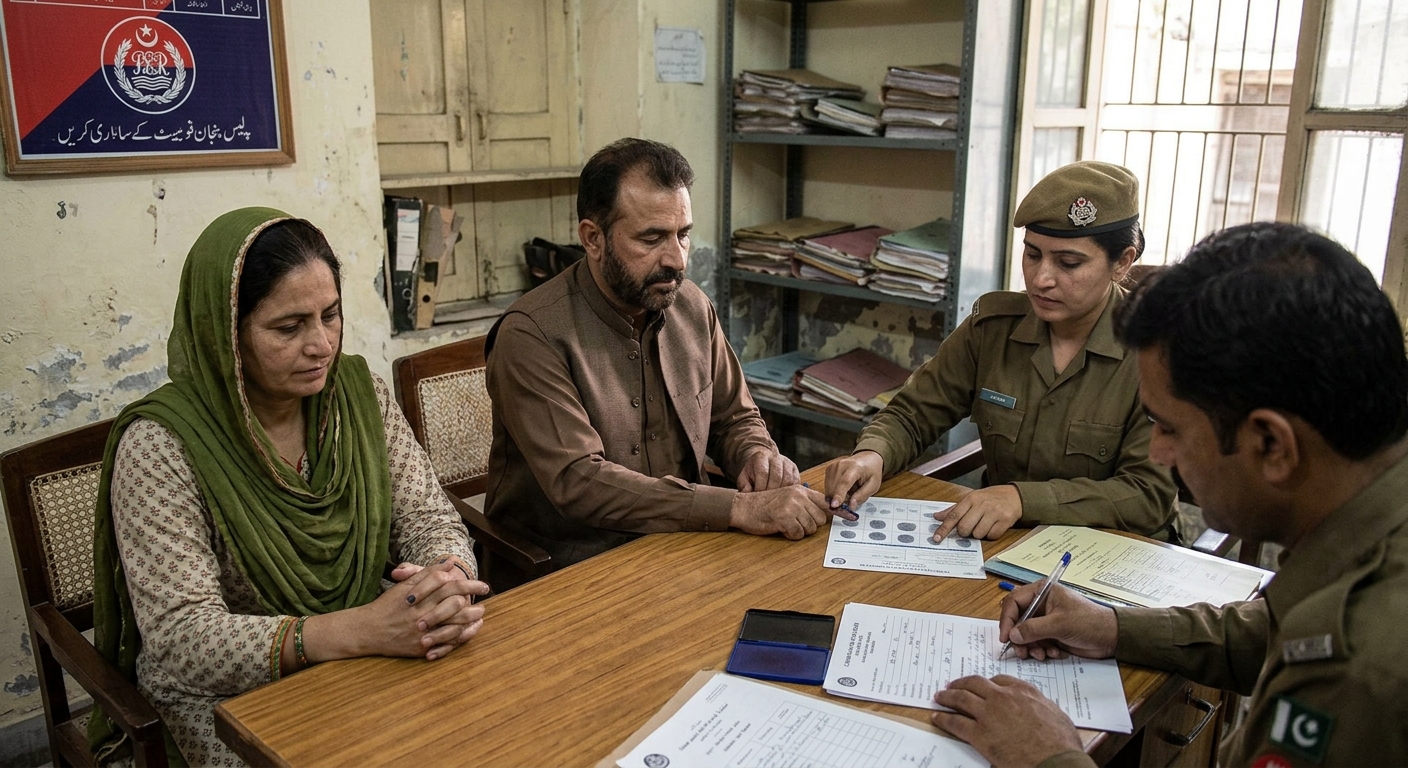
Do I need to visit a police station at all? In Punjab, Sindh, and KP, most applicants complete the entire process online without visiting a station. In Balochistan, Gilgit-Baltistan, and some smaller KP districts, a single visit may still be required for fingerprinting or document verification.
If your case involves multiple past addresses, an old FIR that needs clarification, cross-district verification, or a rejected application that needs to be appealed, it’s worth getting proper legal guidance rather than resubmitting blindly and losing more time. Jamali Law Associates can review your situation, help you apply through the correct provincial channel, and follow up with the relevant police office on your behalf where needed.





Online FIR Check By CNIC Pakistan: Complete Province-Wise Guide (2026) - Jamali Law Associates
3 weeks Ago
[…] I check someone else’s FIR using their CNIC? No. FIR and criminal records are treated as private information, and provincial police systems are designed so that individuals […]